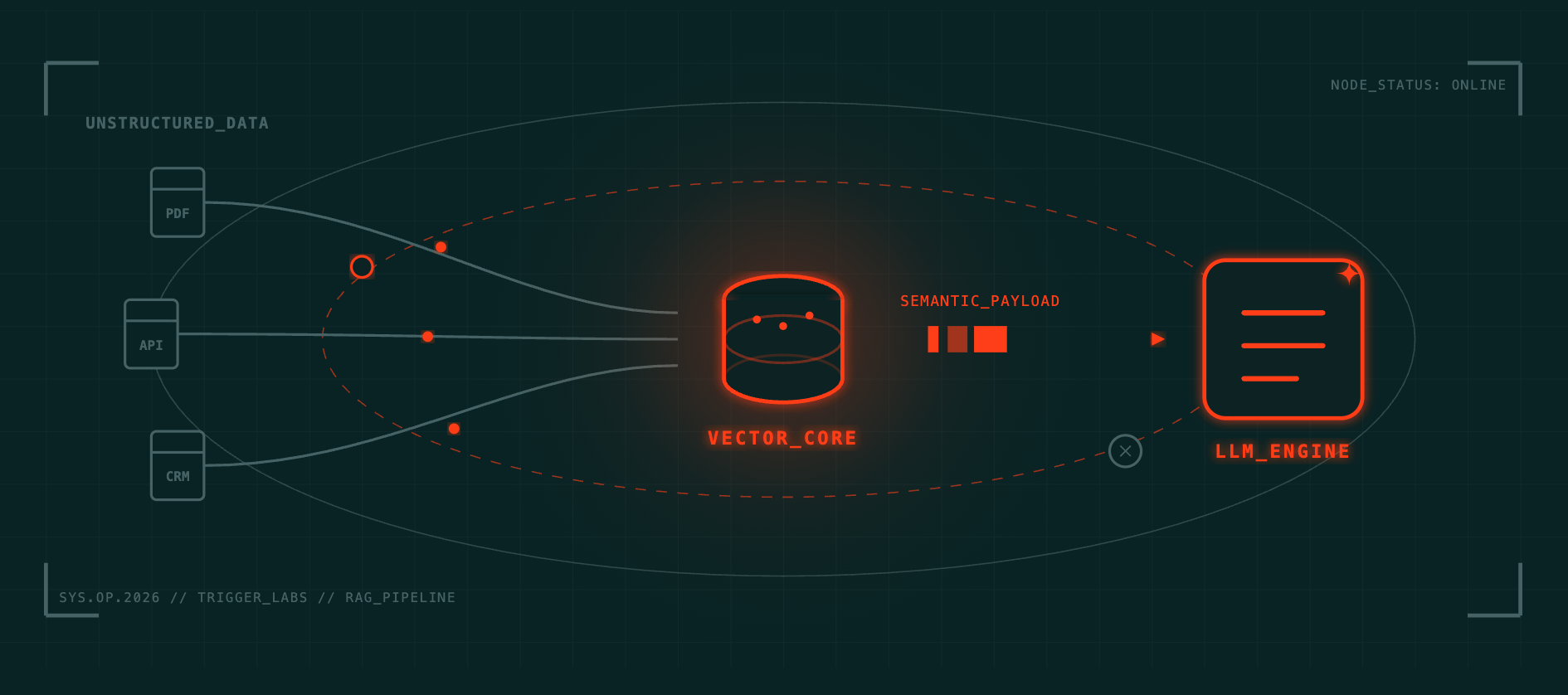
Not long ago, fitting a few dozen pages of documentation into an LLM prompt was a technical hurdle. Today, when AI models began releasing massive context windows capable of ingesting millions of tokens at once (equivalent to dozens of books), many predicted the “death of RAG.” The assumption was that if an AI can hold your entire database in its memory at once, there’s no need to retrieve specific snippets.
However, in practice, RAG (Retrieval-Augmented Generation) and long-context models solve entirely different problems. Pushing everything into a massive context window is a brute-force tactic. For sustainable, scalable, and secure AI workflows, precise retrieval remains a foundational piece of modern AI architecture.
The Massive Context Illusion
Processing millions of tokens for every single user query instead of using an organized data architecture introduces major operational bottlenecks:
- Prohibitive Compute Costs: LLM pricing models are tied heavily to input tokens. Sending a massive payload every time a user asks a simple question about a specific client record is highly expensive and drains budgets incredibly fast.
- Severe Latency Spikes: Reading and processing gigabytes of text takes time. A prompt stuffed with excessive context will dramatically slow down your time-to-first-byte (TTFB), introducing significant latency before the AI starts answering.
- The “Lost in the Middle” Phenomenon: While recall in long-context models is improving rapidly, studies repeatedly show that models can still skip or hallucinate details buried deep in the middle of massive document dumps.
“Relying purely on massive context windows is like reading an entire encyclopedia every time you need to look up a single definition. RAG is the index that gets you directly to the right page.”
Why RAG Remains the Enterprise Standard
A properly architected RAG pipeline fundamentally changes how your AI interacts with your business data. Instead of making the LLM read everything, a vector database acts as a high-speed filter. It retrieves the exact three or four paragraphs needed to answer the question and sends only that small chunk to the LLM. This keeps queries lightning-fast and cost-effective.
1. Real-Time and Dynamic Data
Information changes by the second—inventory levels drop, stock prices shift, and news breaks. Updating a massive prompt context every time a single data point changes is highly inefficient. With a RAG system, you simply update your vector database, and the AI instantly has access to the most current information the next time it searches.
2. Enterprise Access Control
In a business environment, data security is paramount. You cannot simply feed an entire company’s Google Drive into an LLM, because the AI might accidentally summarize confidential HR files for an entry-level employee. RAG systems sit on top of traditional database permissions. When a user asks a question, the retriever only fetches documents that specific user has permission to see, ensuring the LLM only generates answers from authorized data.
3. Traceability and Hallucination Mitigation
Because RAG retrieves specific, targeted chunks of information and hands them to the LLM as source material, it allows for deterministic citations. If the AI makes a claim, the system can point to the exact document, page, and paragraph it pulled the information from, making it much easier to audit and trust the output.
The New Standard: Hybrid Systems
Rather than replacing RAG, long context windows have actually made RAG much better. We are now seeing hybrid architectures where RAG is used to pull slightly larger, richer chunks of data, which the long-context LLM can then reason across.
| Feature | Standard RAG | Pure Long Context |
|---|---|---|
| Best For | Querying a massive, company-wide database | Deep analysis of a specific, static set of files (e.g., summarizing one long legal case) |
| Cost per Query | Low (small prompt) | High (massive prompt) |
| Latency | Fast | Slower (time to first token can be high) |
| Data Updates | Instant (update the database) | Requires re-processing the context |
Ultimately, a sophisticated AI setup doesn’t rely on brute-forcing tokens. By leveraging structured Retrieval-Augmented Generation, you build a system that is significantly faster, exponentially cheaper, and strictly tethered to your single source of truth.
